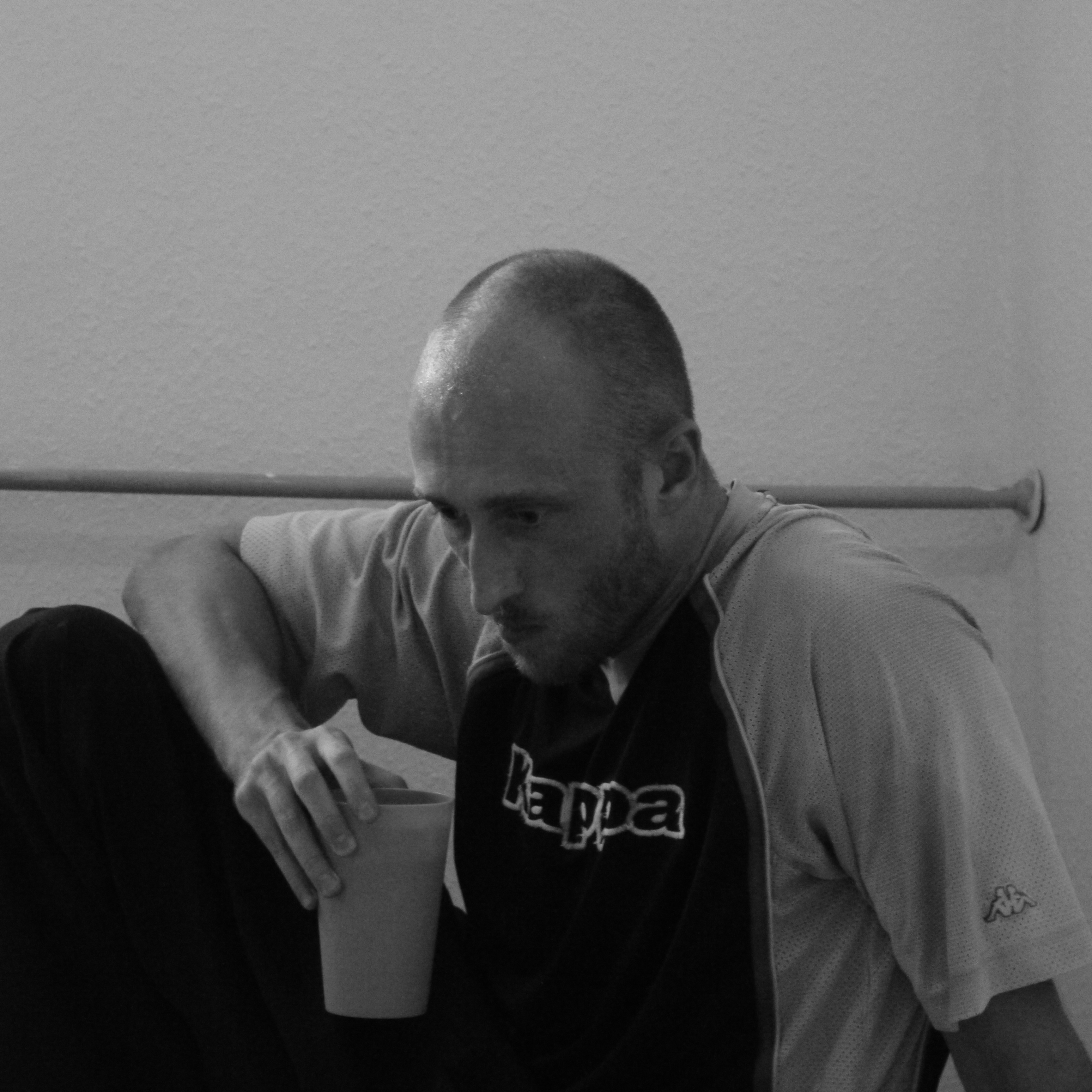
IN PROCESS: 30 ROUNDS
Grounded in the practice of BREAKING, Arian Šajina delves deeper into one of the discipline's emerging rituals: 30 ROUNDS.
Grounded in the practice of BREAKING, Arian Šajina delves deeper into one of the discipline's emerging rituals: 30 ROUNDS.
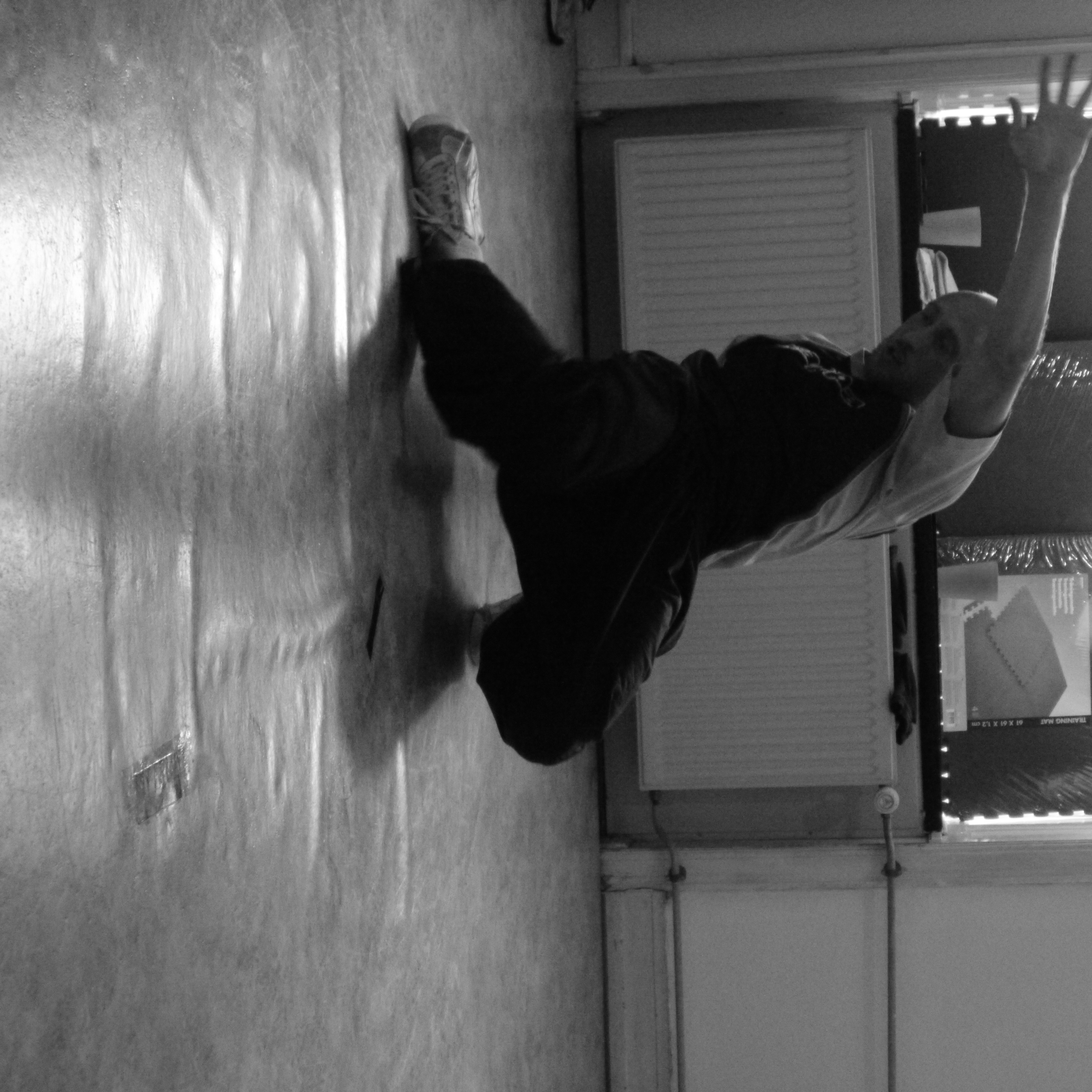
Arian's praxis treats theatre as a space that holds and endures questions, shaped by a movement vocabulary rooted in breaking, and by his position as someone who entered performing arts from its periphery.
The narrative around AGING in breaking is still forming: for young breakers, progress means expanding what the body can do – but it’s uncharted what NEW MEANINGS a deepening of one’s praxis can acquire once the body’s range of motion and strain begin to contract.
One emerging AGE-RELATED RITUAL is that upon turning 30, a breaker battles their peers for 30 consecutive exchanges of improvised dance phrases: They do 30 rounds. Since a round is usually a physically intense phrase lasting about half a minute, and repetition is considered taboo, doing 30 rounds demonstrates maturity of practice and functions as a RITE OF PASSAGE TO ELDERSHIP.
At HAUT, Arian will explore the preparation for this rite of passage as an experimental process that treats the studio as both practice spot and stage laboratory.
ABOUT BREAKING
BREAKING is a dance form and subculture that emerged from the Hip Hop block party environment of the 1970s, in the Black and Puerto Rican communities in the Bronx, New York. Its early influences range from jazz, tap, and salsa, to Cossack dance, gymnastics, and Kung Fu movies.
In terms of performance, breaking draws heavily from the AFRICAN AMERICAN traditions of call and response, and the cypher:
A circle of dancers where each dancer takes a turn to dance. Since then, breaking has spread across the globe, entered popular culture, expanded its movement vocabulary, and codified its norms and aesthetics. Today, it’s held in tension between commercial competitions, underground jams, professional athleticism, and stage translation.
For this residency, Arian has invited Marco Payer, Tunde Ade, Dung Chinh Nguyen aka Slowz, and Connor Gribben to work with him.
Together, they will reflect on breaking as a cultural practice shaped by migration, solidarity, and adversity, and what tensions surface while coming of age in that culture. With this framing, they will approach its movement grammar and social cues as a familiar territory they inhabit and as gathering ground for staging material.
In addition, Arian has invited Tijana Mišković to help him navigate the work’s transcultural dimension — in particular the one spanning the cultural space between Denmark and former Yugoslavia — and offer an intergenerational link between artists of the Balkan diaspora.
Credits:
Viola Luise Barner organised the 30 rounds jam in Berlin in April 2022. Arian was part of the cypher in which she did her 30 rounds — an experience that planted one of the seeds that grew into this residency.
Marco Payer directed the 2022 residency titled De|code where Arian participated as a dancer and which for Arian opened the conversation about responsible stage translation of breaking.
Break Forward is an association that provides weekly practice spots for the Copenhagen breaking community. OT Werkstattstraße Nippes is a youth house in Cologne and was the staple practice spot during Arian’s stay in Germany. Društveni Centar Rojc is a community center in Pula where Arian first practiced breaking.
The Real Deal in Oslo, Ruff Enough in Dornbirn, King of the Concrete in Ljubljana, and B-Urban in Vodnjan were formative jam experiences that shaped Arian’s approach to breaking.
Vlado Smud aka Atomic Roc, representing FreeStyle Kingz and Balkan Mafia, is an elder who in direct and indirect ways provided an intergenerational link for Arian.
Valentin Alfery provided advice on the use of tape for the scenography.
Photographer: Marco Payer
Arian Šajina is rooted in the culture of breaking: Having started in 2008, he has — at the age of 30 — spent more of his life breaking than not. In his work, he searches for a language of his own while remaining grounded in the lived experience that breaking as a culture is built on. Concretely, this has led him to a research method that aspires to develop a staging practice answerable to breaking while remaining deeply personal; research intimately linked to his own timeline within the discipline.
Born in Pula, Croatia in 1996, displaced to Cologne, Germany in 2013 and since 2019 based in Copenhagen, Denmark, he considers the Balkans his cultural heritage. He represents Istra Ti Materina crew, and holds a bachelor’s degree in Mathematics and a master’s degree in Computer Science.